Table of Contents
ToggleWhen a family member falls ill or requires long-term supervision, the financial strain can be just as overwhelming as the emotional toll. At Health Asia Ltd, our care coordinators meet with dozens of families every week who are terrified of draining their savings on medical care. Finding affordable nursing home care in Dhaka does not mean you have to compromise on safety or compassion. It simply requires knowing how the local healthcare market operates, understanding exactly what you are paying for, and avoiding predatory pricing models.
Here are the five most effective strategies to secure high-quality, budget-friendly nursing support for your loved ones.
The wrong choice can lead to frequent hospital readmissions, which ultimately costs far more than hiring the right professional from day one.
As Dhaka’s population ages and hospital beds become increasingly expensive, the demand for at-home medical support has skyrocketed. According to industry data, home recovery reduces overall medical expenses by up to 40% compared to prolonged hospital stays.
“Affordable” should never mean “unqualified.” Hiring an untrained individual off the street for a fraction of the cost is a massive safety risk. True affordability comes from paying a fair market rate for the exact level of care your patient needs—no more, no less.
Overpaying often happens when families hire highly qualified clinical nurses to do basic custodial tasks.
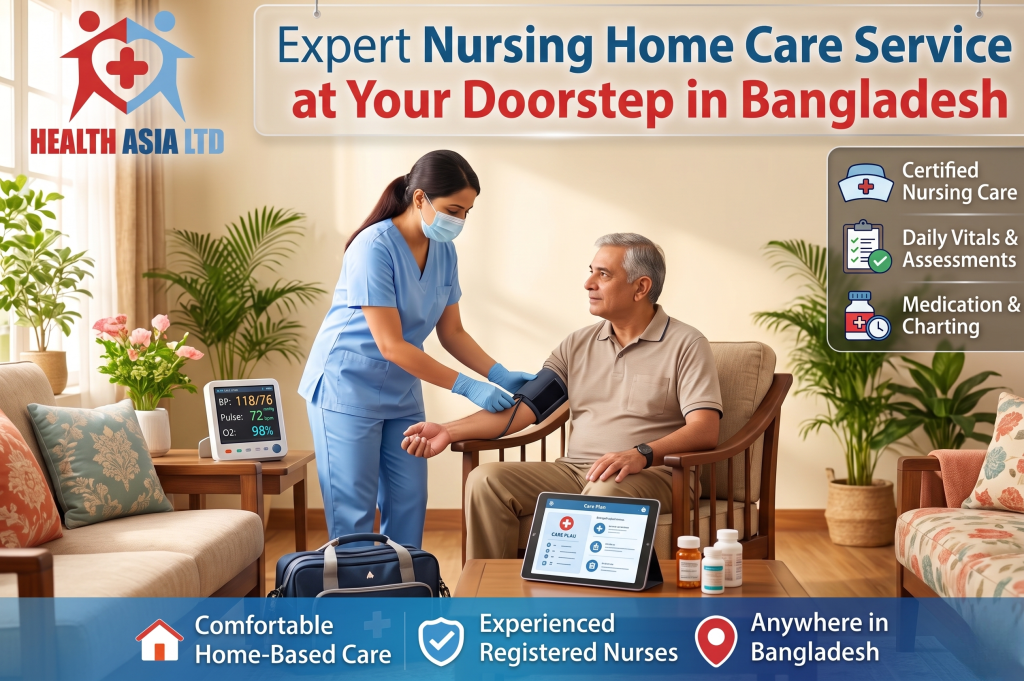
If your loved one needs IV lines, catheter changes, or oxygen management, you must hire a registered nurse. However, if they only need help walking to the bathroom, eating, and bathing, a trained caregiver (attendant) is completely sufficient and significantly cheaper.
Post-surgery recovery usually requires intensive, short-term skilled nursing (e.g., 7 to 15 days). Long-term conditions like Alzheimer’s require ongoing, lower-intensity supervision. Agencies price these contracts differently, offering steep discounts for long-term commitments.
Do not self-diagnose your loved one’s needs. Ask the discharging doctor for a written care plan detailing the necessary medical interventions. Reputable agencies will use this to recommend the most cost-effective tier of staff.
Never settle for the first quote you receive. The home healthcare market in Bangladesh is highly competitive.
Look beyond the price tag. Evaluate their response time, their policy on replacing a nurse if someone falls sick, and their transparency regarding employee background checks.
Dhaka has a mix of established agencies. While Health Asia Ltd focuses on premium, medically supervised care at fair rates, you will also see names like Maisha Care and Caregiver Agency BD. Always compare 2 or 3 providers to gauge the current market baseline.
Walk away immediately if an agency demands 100% payment upfront, refuses to provide a physical office address, or cannot produce the nurse’s identification and training certificates upon request.
A lower price is often the result of an agency cutting corners on staff qualifications.
A clinical nurse must hold a Diploma or BSc in Nursing and be registered with the Bangladesh Nursing and Midwifery Council (BNMC). If they are handling medical procedures, this is non-negotiable.
Ensure the agency is licensed by the Directorate General of Health Services (DGHS) or operates as a legally registered medical service company with a valid Trade License and TIN.
Hidden fees can quickly turn an “affordable” contract into an expensive nightmare.
Agencies usually bill in 12-hour shifts. A daytime shift is often slightly cheaper than a night shift. Booking two 12-hour shifts for 24/7 care usually comes with a slight package discount compared to booking them individually.
Clarify who pays for the nurse’s daily transport and meals. Many budget agencies quote a low base rate but require the family to provide three meals a day and pay for rickshaw fares, which drastically increases the actual monthly cost. Ensure Eid bonuses are also discussed upfront.
Hourly pricing is only cost-effective for specific tasks (like a 1-hour visit to change a dressing). For any need exceeding 4 hours a day, a monthly package will save you thousands of Taka.
If you are committing to a 3-month or 6-month contract, ask for a long-term retention discount. You can also negotiate to provide meals yourself in exchange for a lower monthly fee.
Affordable care is only valuable if the patient is safe and well-treated.
Consider installing a simple Wi-Fi CCTV camera in the patient’s room (with the nurse’s knowledge). This provides peace of mind when you are at the office and ensures accountability.
Your nurse should maintain a daily logbook recording blood pressure, SpO2, food intake, and medication times. The agency supervisor should also check in weekly.
If your nurse becomes negligent or chronically late, immediately contact the agency’s management. A legitimate agency will swap the caregiver within 24 hours without any extra fees.
You can stretch your healthcare budget further with a few smart strategies.
If your loved one needs a caregiver and weekly physiotherapy, book them through the same agency. Providers usually offer a 10% to 15% discount for bundled medical services.
If you work from 9 AM to 5 PM, only hire a caregiver for those specific hours. You and your family can share the evening and weekend shifts to cut your monthly bill in half.
Ask the agency for a 3-day paid trial. This ensures the nurse’s personality matches your loved one’s temperament before you lock yourself into a massive monthly payment.
Based on current 2026 market rates in Dhaka, here is what families should budget for a 12-hour daily shift (monthly basis):
Expect to pay between 18,000 BDT and 25,000 BDT per month for an experienced, non-medical caregiver to handle hygiene, feeding, and companionship.
Expect to pay between 30,000 BDT and 38,000 BDT per month for a registered nurse who can monitor vital signs, manage oral medications, and oversee patient stability.
For around-the-clock ICU-level home care requiring two shift nurses, prices range from 55,000 BDT to 75,000 BDT per month.
Navigating the healthcare landscape in Bangladesh does not have to drain your family’s finances. By clearly identifying whether your loved one needs a clinical nurse or a general attendant, verifying agency credentials, and watching out for hidden fees, you can secure compassionate and affordable support. Keep your expectations grounded in realistic market rates, and never hesitate to negotiate long-term packages to ensure your family gets the best possible value.
Get premium, transparent, and affordable home nursing support tailored to your budget—contact Health Asia Ltd today to schedule a free care assessment.
The most affordable option is a general caregiver or attendant. They focus on non-medical tasks like bathing, feeding, and mobility assistance, usually costing between 18,000 to 25,000 BDT per month for 12-hour shifts.
Look for agencies with registered physical offices, valid trade licenses, DGHS compliance, transparent pricing structures, and positive, verifiable reviews from previous clients.
Yes. Most agencies in Dhaka operate on 12-hour shift models. You can easily hire a nurse strictly for the 8 AM to 8 PM day shift or the 8 PM to 8 AM night shift based on your family’s schedule.
A standard package typically includes the nurse’s salary, agency supervision, and a replacement guarantee if the staff falls sick. Meals, transport, and medical supplies are usually extra unless negotiated otherwise.
Often, yes. Families should ask upfront who is responsible for the nurse’s daily meals, transport costs, and festival bonuses (like Eid), as these can add thousands of Taka to the monthly expense.
Hiring directly is initially cheaper as there is no agency fee. However, if the nurse quits suddenly or falls ill, you are left stranded. Agencies provide the vital safety net of background checks and instant replacements.
No. Unregistered caregivers or attendants are legally and medically not allowed to perform invasive tasks. Only a registered nurse (Diploma/BSc) should administer IVs or injections.
Yes. If you commit to a 3-month or 6-month care plan (common for stroke or Alzheimer’s patients), most agencies will offer a reduced monthly rate compared to a short-term 15-day contract.
Absolutely. Reputable agencies always prioritize patient comfort and cultural sensitivity, allowing you to specifically request a male or female caregiver based on your loved one’s preferences.
You should immediately notify the agency’s management team. A professional home healthcare provider will assess the situation and dispatch a replacement nurse within 24 to 48 hours at no additional charge.
Fill out the form below and our Care Advisors will get back to you with care information you need.