Table of Contents
ToggleFinding a reliable patient care home service in Bangladesh can make daily care safer, easier, and more comfortable for both patients and families. When a loved one is elderly, recovering from illness, bedridden, weak after surgery, or living with a chronic condition, regular hospital visits may not always be practical.
Professional home healthcare brings trained support to the patient’s own home. This helps the patient stay in a familiar place while receiving daily care, monitoring, personal assistance, and basic health support. It also gives family members peace of mind because they do not have to manage everything alone.
In Bangladesh, many families now search for patient care services, home care services list, best home care BD, patient care Dhaka, caregiver support, and care at home services. The reason is simple. Families want trusted help that is respectful, trained, and suitable for the patient’s condition.
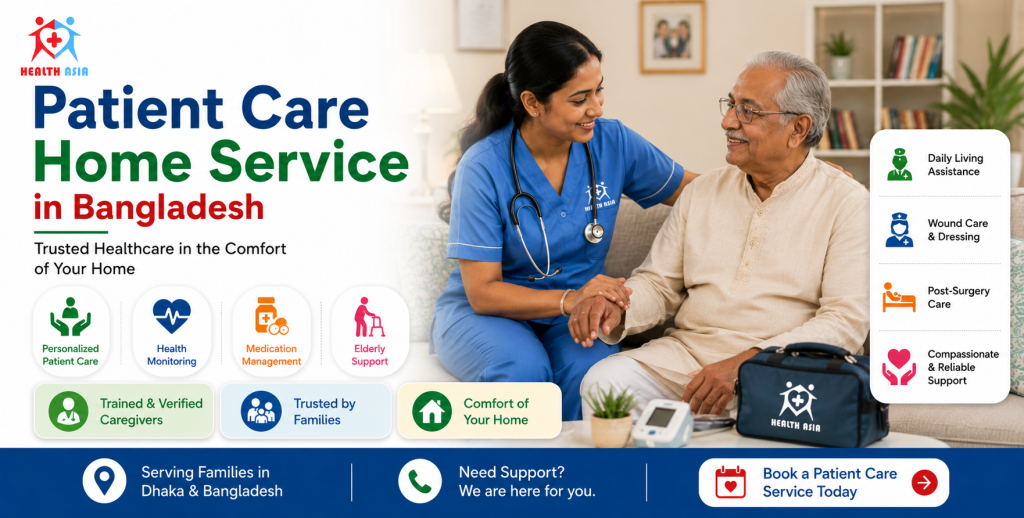
For families who need organized home healthcare support, Health Asia provides patient care home service in Bangladesh with a focus on comfort, safety, dignity, and family confidence.
Patient care home service means professional care support provided at the patient’s home. The service may include daily patient assistance, elderly care, caregiver support, basic monitoring, hygiene care, feeding support, mobility help, post-illness support, and nursing coordination when needed.
This type of service is helpful for patients who do not need hospital admission but still need regular care. It can also support people who have returned home after treatment and need help during recovery.
A good home healthcare service does not replace doctors or hospitals. Instead, it supports the patient at home by following care instructions, maintaining routine, and helping the family manage daily responsibilities.
Patient care and home nursing are connected, but they are not always the same. Patient care is broader. It can include personal care, caregiver support, mobility assistance, feeding support, hygiene care, companionship, and daily observation.
Home nursing usually includes more health-related support. A nurse may help with vital signs, wound dressing support, medicine routine support, and doctor-guided care tasks.
Some patients need only caregiver service. Others may need nursing support. Many long-term patients may need a combination of both.
Home healthcare matters because many patients feel more comfortable at home. They can stay close to family, follow familiar routines, and avoid unnecessary travel.
Families also benefit because trained care support reduces stress. Patient care can be physically and emotionally demanding, especially when the patient needs help every day.
With the right home care service, families can manage patient needs more confidently.
Bangladesh has many families caring for elderly parents, recovering patients, stroke survivors, weak patients, and bedridden loved ones at home. In many cases, family members want to provide care but do not have enough time, training, or physical strength.
Traffic, hospital waiting times, busy work schedules, and long-term patient needs make home care services more valuable. A trained caregiver or nurse can support the patient while keeping the family informed.
Professional patient care at home helps create a safer daily routine.
Many family members work outside the home or manage several responsibilities. Caring for a patient throughout the day can become difficult.
A caregiver can help with feeding, hygiene, movement, toileting, companionship, and daily comfort. This support reduces pressure on the family.
Better support also helps the patient feel less neglected and more cared for.
Patient care is not only about physical help. It is also about dignity, patience, and respectful behavior.
A weak or elderly patient may feel uncomfortable depending on others. A trained care provider should support the patient gently and respectfully.
Good care protects both comfort and emotional well-being.
Traveling to hospitals or clinics can be hard for elderly, weak, or bedridden patients. Dhaka traffic and long waiting times can make it even more stressful.
Home care services reduce unnecessary movement when hospital care is not required.
This is especially helpful for patients who need daily support but are medically stable.
Patient care services can help many types of people. It is not only for older adults. Patients recovering from illness, surgery, stroke, injury, or long-term weakness may also need home support.
The right service depends on the patient’s condition, mobility level, doctor’s advice, and family capacity.
A proper care assessment helps decide whether the patient needs caregiver support, nursing support, or both.
Elderly patients may need help with walking, bathing, dressing, eating, medicine reminders, and daily safety.
Some older adults also need companionship because loneliness can affect mood and routine.
A caregiver can help elderly patients maintain comfort, cleanliness, and daily structure at home.
Bedridden patients need consistent care because they cannot move freely. They may need help with position changes, hygiene, feeding, skin care, diaper changes, and comfort.
Without proper care, bedridden patients may face pressure sores, weakness, discomfort, and hygiene-related problems.
Professional patient care home service can help families manage these daily needs more safely.
After surgery or hospital discharge, patients may still need support at home. They may need help with movement, hygiene, food, medicine routines, and observation.
Care at home services can make recovery smoother when the patient is stable enough to stay at home.
A trained care provider can also help families follow the care plan more consistently.
People with chronic conditions may need long-term support. This can include patients with diabetes, heart disease, neurological issues, respiratory problems, kidney disease, or age-related weakness.
Home care helps maintain daily routines and observe changes in the patient’s condition.
Serious changes should always be discussed with a doctor.
A complete home care services list may include many types of support. However, the exact service should be selected based on the patient’s condition.
Some families need basic caregiver support. Others need nursing help, elderly care, mobility support, or post-treatment care.
A good provider should explain what is included and what requires medical supervision.
Daily patient assistance may include bathing, dressing, grooming, feeding, toileting, walking help, sitting support, and basic comfort care.
These tasks may sound simple, but they are very important for patient dignity and hygiene.
Trained support can reduce discomfort and prevent careless handling.
Hygiene care is important for every patient, especially those who are weak, elderly, bedridden, or recovering.
Personal care may include sponge bathing, oral care, hair care, diaper changing, skin cleaning, and changing clothes.
Clean care helps the patient feel fresh and comfortable.
Some patients need help with eating and drinking. Weak patients may eat slowly, lose appetite, or need encouragement.
A caregiver can support feeding according to family and doctor instructions.
If a patient has swallowing difficulty, vomiting, or cannot eat properly, medical advice is needed.
Patients may need help moving from bed to chair, walking to the bathroom, or changing position.
Safe movement is important because wrong handling can cause falls or injury.
A trained caregiver can support movement carefully and help reduce risk.
Basic observation may include checking general comfort, appetite, sleep, mood, movement ability, and visible changes.
A nurse may also support basic monitoring such as temperature, blood pressure, pulse, or oxygen level when needed and appropriate.
Monitoring helps families notice changes early and contact a doctor when required.
Patient care Dhaka is a growing need because many families in the city face busy schedules, traffic challenges, and limited time for full-day patient support.
Dhaka families often care for elderly parents, recovering patients, and long-term patients at home. Many want professional support but do not want unnecessary hospital stays.
Home care services in Dhaka can help patients receive care in a familiar setting while families manage daily life more easily.
Moving a weak patient through Dhaka traffic can be difficult. Even a simple checkup can take hours when travel and waiting time are included.
Home care reduces unnecessary travel for stable patients who need daily assistance.
This saves energy for both patients and family members.
Many Dhaka families have working members who cannot stay with a patient all day.
Flexible home care support can help during daytime, nighttime, or full-day care needs.
The right schedule depends on the patient’s condition and family availability.
The best home care BD service should be reliable, trained, respectful, and transparent. Families are trusting someone with a loved one, so quality matters.
A trustworthy service should ask about the patient’s condition before assigning staff. It should also explain service scope, duty hours, responsibilities, and communication process.
Good home care is not only about availability. It is about safe and respectful support.
Care staff should understand patient handling, hygiene, safety, and communication.
Experience matters because elderly care, bedridden care, and recovery care each need different skills.
Families should ask whether the assigned caregiver or nurse is suitable for the patient’s condition.
Clear service scope prevents confusion. Families should know what the caregiver or nurse will do and what is not included.
For example, personal care, feeding help, and mobility support may be caregiver tasks. Medical procedures should be handled only by qualified professionals under proper guidance.
Before booking, ask for a clear explanation of duties.
Communication is very important in home healthcare. The care provider should update the family about patient condition, routine, concerns, and any changes.
Family members should also share medicine schedules, doctor instructions, food preferences, allergies, and emergency contacts.
Clear communication supports safer care.
Care at home services are very useful for elderly people who need help with daily life. Many older adults want to stay at home instead of moving to a facility.
Home care helps them remain close to family while receiving support.
The goal is to maintain comfort, dignity, and safety.
Elderly patients may need help waking up, bathing, dressing, eating, walking, and resting.
A caregiver can support the routine without rushing the patient.
A calm and respectful approach helps elderly people feel more secure.
Many elderly people feel lonely, especially when family members are busy.
A caregiver can provide companionship, conversation, and regular presence.
Emotional comfort is an important part of good patient care.
Falls are a common risk for elderly patients. Weakness, poor balance, slippery floors, and low lighting can increase danger.
A caregiver can help during walking, sitting, standing, and bathroom use.
Families should also keep floors clear and provide proper lighting.
Bedridden care needs patience and consistency. These patients depend heavily on others for daily activities.
Professional support helps maintain hygiene, comfort, and routine.
Family members also get relief from physically demanding tasks.
Bedridden patients may need regular position changes to reduce pressure on the skin.
Careful turning also improves comfort and helps reduce stiffness.
A trained caregiver can support safe movement without causing unnecessary pain.
Skin care is very important for bedridden patients. Sweat, moisture, and pressure can create discomfort.
Regular cleaning, dry bedding, and skin observation help maintain hygiene.
Any wounds, redness, swelling, or unusual changes should be reported to family and doctor.
A bedridden patient may need support with food and water.
The caregiver should help the patient sit properly when possible and follow family or doctor instructions.
If the patient has choking risk or swallowing problems, medical guidance is needed.
Recovery patients need support after illness, surgery, stroke, injury, or hospital discharge. They may be weak, tired, or unable to manage daily tasks independently.
Home care can help them rest while still receiving practical assistance.
Proper support can make the recovery period less stressful.
After discharge, families often feel unsure about daily care. They may need help with movement, hygiene, food, medicine reminders, and observation.
A caregiver or nurse can support the routine at home.
Doctor instructions should always guide recovery care.
Some patients need help walking again after illness, surgery, or injury.
Care should be gentle and based on medical advice.
A caregiver can support safe movement and prevent unnecessary falls.
Recovery becomes easier when the patient has a clean room, proper meals, enough rest, and regular care.
A care provider can help maintain routine and reduce family pressure.
Comfort is important because recovery can be emotionally difficult.
Safety and hygiene are essential in home healthcare. Patients may be weak, elderly, recovering, or more vulnerable to infection.
A professional care provider should follow basic hygiene practices and safe patient-handling methods.
Families should also keep the care area clean, organized, and easy to access.
Hand hygiene is one of the most important safety steps in patient care. Clean hands can help reduce the spread of germs.
Caregivers and nurses should clean their hands before and after patient contact, before feeding, after toileting support, and after touching soiled items.
For general health information, MedlinePlus explains that home care services can support people who are aging, chronically ill, recovering from surgery, or living with disability.
The patient’s room should be clean, ventilated, and free from unnecessary clutter.
Medicine, water, tissues, waste bins, and emergency contacts should be easy to find.
A clean room helps both the patient and caregiver work safely.
Moving a patient requires care. Pulling, rushing, or lifting incorrectly can cause injury.
A trained caregiver understands how to support movement more safely.
Family members should ask for guidance if they are unsure how to help.
Choosing the right patient care home service in Bangladesh requires careful thought. You are choosing support for someone who may be weak, sick, elderly, or dependent.
Do not choose only based on fast availability. Check training, experience, communication, service scope, and reliability.
The right provider should make the family feel informed and confident.
Before booking, explain the patient’s age, condition, mobility level, medicine routine, food needs, and any doctor instructions.
This helps the provider suggest the right type of care.
Accurate information leads to better service matching.
Ask whether the assigned staff has experience with elderly care, bedridden care, recovery care, or chronic illness support.
Different patients need different skills.
Experience helps caregivers respond more calmly and responsibly.
Duty hours should be clear before service starts. Families should know whether they need hourly, daily, night, full-day, or live-in support.
Responsibilities should also be listed clearly.
This avoids misunderstanding later.
Sometimes a caregiver may be unavailable due to illness, emergency, or schedule changes.
Ask whether backup support is available.
Reliable providers should have a plan for service continuity.
Patient care services are not only about the patient. They also help the full family system.
When one person needs regular care, the whole household feels the pressure. A professional caregiver or nurse can reduce that burden.
Support at home helps families balance care, work, rest, and emotional stress.
Family caregivers often become tired because they handle care day and night.
Professional support gives them time to rest, work, and manage other responsibilities.
This can improve the overall care environment.
Patients often feel better when the day follows a routine.
Regular meals, hygiene, rest, medicine reminders, and movement support can make care more stable.
A trained caregiver can help maintain this routine.
Families feel more confident when a trained person is helping.
They can ask questions, share concerns, and get daily updates.
This creates better coordination around the patient.
Some businesses and institutions may also need patient care support. Offices, events, clinics, residential facilities, and organizations may require trained care staff for specific situations.
This service should be planned based on the setting and care need.
A provider should understand the environment before assigning staff.
Some clinics or care facilities may need patient attendants, caregivers, or nursing support for short-term needs.
The assigned staff should understand patient handling and hygiene.
Clear duty instructions are important in these settings.
Some organizations may need basic health support during events or office programs.
This may include patient assistance, first-aid support, or temporary nursing help depending on the requirement.
Planning should happen before the service date.
Patient care at home is helpful, but it has limits. Some situations require urgent medical care, hospital admission, or doctor evaluation.
Families should not delay emergency treatment if the patient shows serious symptoms.
Home care supports stable patients. It should not replace emergency medical response.
Seek urgent medical care if the patient has chest pain, severe breathing difficulty, stroke symptoms, loss of consciousness, uncontrolled bleeding, severe allergic reaction, or sudden serious weakness.
Do not wait for routine home care during emergencies.
Hospitals are necessary for serious and life-threatening situations.
Caregivers and nurses support the patient’s daily routine, but doctors make medical decisions.
Medicine changes, new treatments, and diagnosis should always come from a qualified doctor.
Safe home care works best when the family, care provider, and doctor stay connected.
Choosing a trusted provider can make home healthcare easier for families. You need trained support, respectful behavior, and clear communication.
Health Asia offers patient care home service in Bangladesh for elderly care, recovery support, bedridden care, caregiver service, and nursing coordination.
The service is designed to help families manage patient care with more comfort, structure, and confidence.
Patient-centered support means care is built around the person’s needs, comfort, and dignity.
Every patient has a different condition and routine.
A good service should respect those differences.
Families need updates, clarity, and support.
Good communication helps everyone understand the patient’s condition and daily routine.
This makes care more organized and less stressful.
Searching for patient care home service in Bangladesh is often the first step toward safer and more comfortable care for a loved one. Whether the patient is elderly, bedridden, recovering, chronically ill, or weak after hospital treatment, professional home healthcare can make daily life easier.
A trusted provider should offer trained staff, clear communication, respectful care, hygiene awareness, and proper service matching. The goal is not only to help the patient but also to support the family.
Home care does not replace hospitals, doctors, or emergency treatment. However, it can provide valuable daily support when the patient is stable enough to stay at home.
For families in Dhaka and across Bangladesh, professional patient care services can reduce stress, improve comfort, and help patients receive care with dignity in their own home.
Patient care home service means trained care support provided at the patient’s home. It may include personal care, feeding support, hygiene care, mobility help, monitoring, caregiver support, and nursing coordination.
Elderly patients, bedridden patients, post-surgery patients, recovery patients, chronic illness patients, and people with limited mobility may need patient care services at home.
Yes, patient care Dhaka services are available for families who need home healthcare, caregiver support, nursing help, elderly care, and recovery support at home.
A home care services list may include bathing help, feeding support, medicine reminders, mobility assistance, hygiene care, patient observation, caregiver support, and nursing support when needed.
Caregiver service focuses on daily activity support such as feeding, bathing, walking, and companionship. Nursing service includes more health-related tasks such as monitoring, dressing support, and doctor-guided care.
Choose a provider with trained staff, clear duties, good communication, proper service matching, hygiene awareness, and experience with your patient’s condition.
Care at home services can be safe when trained staff follow hygiene practices, safe patient handling, doctor instructions, and clear communication with the family.
Yes, patient care home service can help bedridden patients with position changes, hygiene care, feeding support, skin observation, diaper changing, and daily comfort.
A caregiver may remind the patient about prescribed medicines, but medicine decisions and changes should only be made by a qualified doctor. Nursing tasks should be handled by qualified staff.
Take the patient to hospital during emergencies such as chest pain, severe breathing difficulty, stroke symptoms, loss of consciousness, uncontrolled bleeding, severe allergic reaction, or sudden serious weakness.
Fill out the form below and our Care Advisors will get back to you with care information you need.