Table of Contents
ToggleIt happens quietly, usually. A missed dose of medicine. A fall in the bathroom that nobody saw. A phone call from your mother that doesn’t quite make sense, and you realise — sitting in traffic on your way to work, far from Dhanmondi or Mirpur or wherever home used to feel simple — that your parent can no longer manage entirely alone. This guide walks you through exactly what elderly home care in Bangladesh looks like, who needs it, what it costs, and how to arrange it without guesswork.
We serve all Dhaka districts, including Mirpur, Dhanmondi, Gulshan, and Uttara. Need help today?
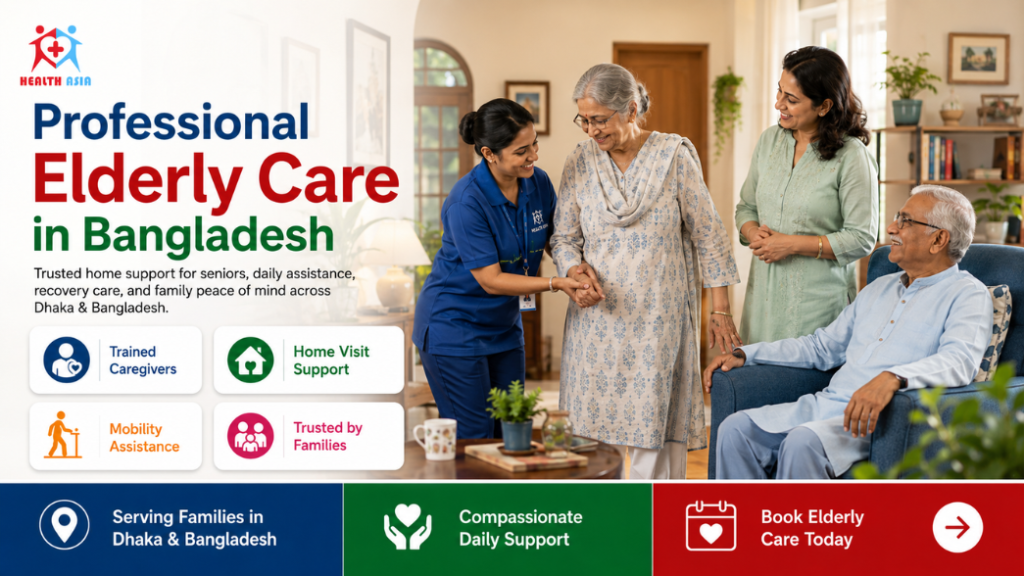
Elderly care at home means trained caregivers, nurses, or support staff come to your parent’s own house to help with daily living, medical monitoring, or both — instead of your parent moving into a residential facility. In Bangladesh, this typically includes personal care (bathing, mobility, dressing), health monitoring (blood pressure, blood sugar, oxygen levels), companionship, and in many cases, registered nursing support for chronic or post-hospital conditions.
According to Bangladesh Bureau of Statistics (BBS) data, the population aged 65 and above reached 6.14 percent in 2023, up from 5.67 percent the year before — and the old-age dependency ratio is climbing alongside it. That shift is exactly why home care has moved from a niche service to a mainstream need for families across Dhaka.
An old age home relocates your parent into a shared residential facility, away from their own bed, their own kitchen, their own neighbours. Home care brings the support to them instead. The practical difference isn’t just emotional — it’s medical too. A parent who stays in a familiar environment tends to experience less disorientation, especially with dementia or post-surgical recovery, and family members can stay closely involved in day-to-day decisions rather than receiving occasional updates from a facility.
Old age homes still carry social stigma in Bangladesh — many families see placing a parent in one as a failure of duty, however unfair that judgment may be. Home care sidesteps that tension entirely. Your parent stays where they’ve always lived, surrounded by their own belongings and routines, while still receiving professional-level support. For families managing joint households, multiple siblings, or working parents who can’t be present all day, it also solves the practical problem: someone qualified is physically present, even when you can’t be.
Senior care, in this context, simply means structured support — medical, physical, or both — for an older adult who needs more help with daily life than family members alone can reliably provide.
Not every ageing parent needs the same kind of help. The right service depends entirely on the specific situation your family is facing.
A parent living independently after children have moved out or a spouse has passed away faces real risks — missed medication, poor nutrition, falls with no one nearby to help. Even a few hours of daily caregiver support closes that gap without taking away their independence.
Patients discharged after surgery, stroke, or a serious illness often need wound care, mobility assistance, and medication management for weeks before they’re fully steady. A nurse or trained caregiver at home reduces the risk of readmission and gives the family a clear recovery plan to follow.
Dementia changes how a person experiences their own home — familiar rooms can suddenly feel confusing, routines get forgotten, and wandering becomes a real safety concern. Specialised caregivers trained in dementia care use structured routines and calm redirection techniques that reduce agitation far more effectively than family members improvising alone.
Patients who can’t move independently need regular repositioning to prevent pressure sores, assistance with feeding and hygiene, and often catheter or wound care. This is intensive, physically demanding work that benefits enormously from trained hands.
Chronic conditions need daily monitoring, not occasional check-ins. Blood sugar readings, blood pressure tracking, and oxygen saturation checks done consistently — and recorded properly — catch problems early, often before they become emergencies.
Tremors, muscle stiffness, and balance problems make everyday movement — getting out of bed, walking to the bathroom, eating without spilling — genuinely risky without supervision. A caregiver trained in Parkinson’s-specific support reduces fall risk and helps your parent stay mobile for longer, rather than withdrawing from movement out of fear.
Daily hygiene and movement support delivered with dignity and patience, adapted to your parent’s physical ability and comfort level.
Routine vital sign checks performed and logged consistently, so any concerning trend gets flagged early rather than discovered during a crisis.
General help with meals, light housekeeping tied to the patient’s needs, mobility around the home, and companionship throughout the day.
For medical needs beyond general caregiving — injections, wound dressing, catheter care, post-operative monitoring — our nurses are registered with the Bangladesh Nursing and Midwifery Council.
When in-person physician assessment is needed without a hospital trip, we arrange doctor home visits for diagnosis, prescription review, or routine check-ups.
Mobility recovery after stroke, fracture, or surgery, plus ongoing strength and balance work to reduce fall risk — delivered by a qualified physiotherapist in your parent’s own space.
For patients facing terminal or advanced illness, we provide comfort-focused care that manages pain and symptoms while supporting the family through an extremely difficult period.
Physical care is only half the picture. Many elderly parents in Bangladesh struggle with loneliness, especially after losing a spouse or when children move out for work or marriage. Depression in older adults often goes unnoticed because it’s mistaken for “just getting old” — withdrawal from family conversations, loss of interest in food or hobbies, or sleeping far more or far less than usual can all be signs of something that needs attention, not just ageing.
Our caregivers are trained to provide more than physical assistance — consistent daily companionship, conversation, and a familiar presence that reduces the isolation many elderly parents feel when family members are occupied with work and other responsibilities. For parents showing signs of social withdrawal or low mood, regular caregiver visits also give the family an early warning system: someone present daily will notice a change in mood or behaviour long before it becomes visible during a weekly phone call.
If your parent seems unusually withdrawn, low, or disinterested in things they used to enjoy, it’s worth speaking with a doctor — emotional changes in older adults are treatable, not something to simply accept as inevitable.
If your parent needs a few hours of help with bathing, meals, or mobility but is otherwise safe and independent, day shift care is usually enough.
A parent who’s mostly self-sufficient but needs help with specific tasks — getting dressed, preparing meals, attending appointments — typically does well with a caregiver present for set daytime hours.
Parents with a high fall risk, late-night confusion (common with dementia), or medical conditions that need overnight monitoring benefit from a dedicated night caregiver, especially when family members need uninterrupted sleep to function the next day.
Bedridden patients, advanced dementia cases, and those recovering from major surgery generally need round-the-clock coverage. Live-in care also removes the gap between shifts where something could go unnoticed.
Hourly senior care rates in Dhaka generally start from a few hundred Taka per hour depending on the level of medical skill required, while live-in monthly arrangements offer better value for sustained, intensive care. We’ll confirm an exact rate based on your parent’s specific needs.
Already know what your parent needs? Message us on WhatsApp and we’ll match the right caregiver or nurse the same day.
Costs vary based on the level of care required — general caregiver support costs less than skilled nursing care, and round-the-clock live-in arrangements typically offer a better monthly rate than paying hourly across a full day. Government support exists but remains limited: only about a third of Bangladeshis above pensionable age receive any old-age pension, which is part of why private home care has become the realistic option for most urban families. For a detailed breakdown by service type and care hours, see our [complete cost guide for elderly home care in Bangladesh].
We provide elderly home care across all Dhaka districts, with fastest response times in Mirpur, Dhanmondi, Gulshan, Uttara, Mohammadpur, Bashundhara, and Badda. If your area isn’t listed here, message us on WhatsApp and we’ll confirm coverage and arrival time directly.
It’s professional caregiving or nursing support delivered at your parent’s own home, covering anything from daily living assistance to medical monitoring and skilled nursing care.
It depends on the family’s situation, but home care lets your parent stay in a familiar environment while still receiving professional support, which often leads to better emotional and physical outcomes — particularly for dementia patients.
Cost depends on whether you need general caregiving, skilled nursing, or 24-hour live-in support. Contact us for a rate based on your parent’s specific needs.
Yes, we provide 24-hour live-in care for patients who need round-the-clock monitoring or assistance, including bedridden and advanced dementia patients.
Yes, our caregivers are trained in dementia-specific routines, including calm redirection techniques and structured daily schedules that reduce confusion and agitation.
We cover all Dhaka districts, with the fastest response in Mirpur, Dhanmondi, Gulshan, Uttara, Mohammadpur, Bashundhara, and Badda.
Message us on WhatsApp at +8801829-282228. We’ll assess your parent’s needs and arrange a caregiver or nurse the same day.
Yes, many families book elderly home care immediately after hospital discharge. This helps with medicine routines, movement, hygiene, feeding, monitoring, wound care if prescribed, and follow-up coordination so the patient recovers more safely at home.
Fill out the form below and our Care Advisors will get back to you with care information you need.