Table of Contents
ToggleWhen a loved one is discharged from the hospital but still requires medical supervision, finding a reliable home nursing service in Bangladesh becomes a top priority. Whether you are managing an elderly parent’s chronic condition or helping a family member recover from major surgery, balancing medical needs with everyday life is incredibly stressful. Fortunately, the healthcare landscape has evolved, and high-quality, professional medical care can now be delivered directly to your doorstep.
However, bringing a medical professional into your home requires absolute trust. You need to know exactly what services are provided, what the legitimate market costs are in 2026, and how to verify the credentials of the person caring for your family. Here is your complete guide to navigating 24/7 home nursing safely and effectively.
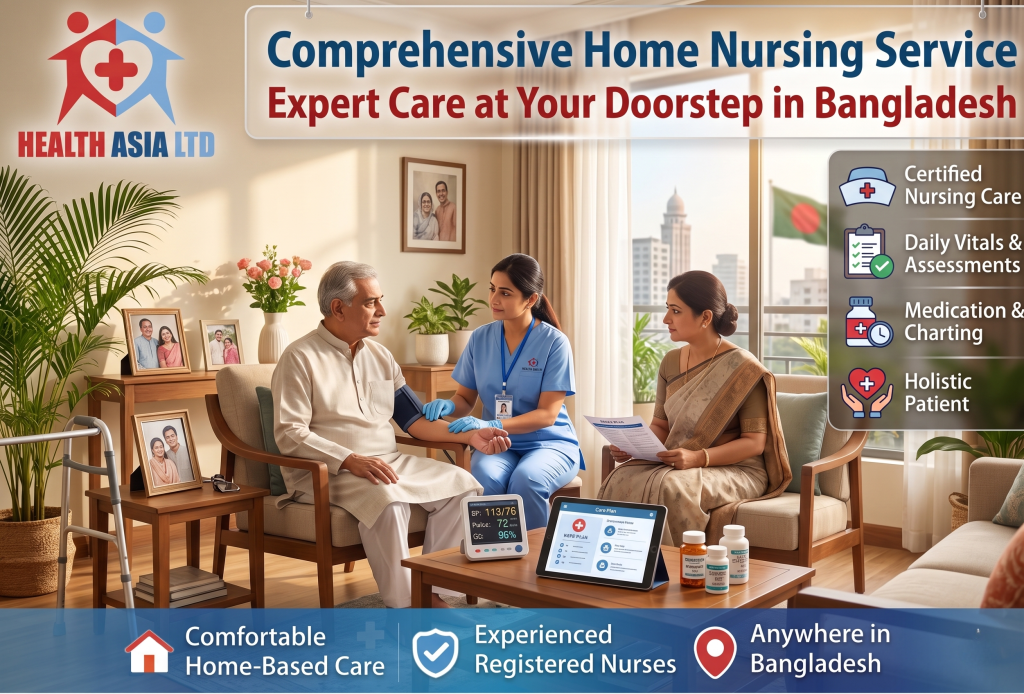
Home nursing service brings clinical expertise into a residential setting. It involves deploying trained, registered nurses to a patient’s home to administer medications, monitor vital signs, and manage post-operative recovery, bridging the gap between a hospital stay and full independence.
Hospital care is built for acute emergencies and life-saving interventions, but it is expensive and exposes vulnerable patients to hospital-acquired infections (HAIs). Home nursing provides personalized, one-on-one attention in a familiar, comfortable environment, drastically reducing patient anxiety and long-term medical bills.
This service is essential for patients who are medically stable enough to leave the hospital but still require clinical oversight. This includes stroke survivors, bedridden elderly individuals, premature newborns, and patients living with feeding tubes, urinary catheters, or oxygen concentrators.
Yes, provided you hire through a legitimate, verified agency. A safe service relies on strict background checks and deploying nurses who hold valid registrations from the Bangladesh Nursing and Midwifery Council (BNMC).
Patient needs vary drastically. Professional agencies offer specialized tiers of care to match different medical profiles.
Focuses on preventing infection immediately after surgery. The nurse manages complex wound dressings, administers IV antibiotics, and monitors for complications like internal bleeding or fever.
Designed for seniors experiencing physical frailty or cognitive decline. While this often involves basic caregiver support for daily tasks, an elderly care nurse also manages multiple daily medications and fall-prevention strategies.
For patients discharged from the Intensive Care Unit who still require high-level monitoring. This includes managing tracheostomies, continuous oxygen therapy, and strict fluid intake tracking.
Involves managing dysphagia (swallowing difficulties) to prevent choking, performing regular turning schedules to prevent bedsores, and assisting with basic physical mobility to prevent muscle contracture.
Specialized support for new mothers recovering from C-sections and neonatal care for premature babies, including strict temperature monitoring and specialized feeding techniques.
Often bundled with nursing care, licensed physiotherapists visit the home to perform targeted exercises, helping stroke or orthopedic patients regain their strength and independence.
End-of-life care focused entirely on comfort. Palliative nurses manage severe pain, administer IV hydration, and provide emotional support to the patient and their family during the final stages of a terminal illness.
A registered home nurse takes on responsibilities far beyond what a general domestic attendant can legally or safely do.
Nurses are certified to perform invasive procedures. They insert and clean catheters, change nasogastric (NG) feeding tubes, and administer intramuscular and intravenous medications exactly as prescribed by the doctor.
For fully bedridden patients, the nurse executes safe sponge baths, manages adult diapers, and ensures the patient is kept clean and dry to prevent severe skin breakdown.
Complex illnesses often require 10 or more pills a day at exact intervals. The nurse organizes pill boxes, manages insulin injections, and ensures zero medication errors.
Maintaining a strict daily logbook of the patient’s blood pressure, SpO2 (oxygen levels), heart rate, and blood sugar, alerting the consulting physician immediately if numbers drop.
Chronic illness is isolating. A compassionate nurse acts as a companion to the patient and a reassuring guide for stressed family members, explaining medical jargon in simple terms.
Round-the-clock care requires structured logistics to ensure the patient is never left unmonitored.
Day shifts (usually 8 AM to 8 PM) are active—the nurse handles feeding, physiotherapy, and doctor visits. Night shifts (8 PM to 8 AM) are observational, focusing on monitoring sleep apnea, managing nighttime oxygen, and assisting with bathroom visits.
A visiting nurse comes for 1-2 hours simply to administer an IV or change a dressing. A live-in (or shift-based) nurse stays for 12 to 24 hours for continuous monitoring. If your patient requires emergency interventions, shift-based care is mandatory.
Trained nurses perform immediate basic life support, stabilize the patient’s airway, administer emergency oxygen, and coordinate with the agency to dispatch an ambulance to the nearest hospital.
Pricing depends entirely on the clinical qualifications of the staff and the hours required.
The price increases if the patient requires ICU-level care, if the location is far from the agency hub, and if the family requires the agency to cover the nurse’s daily meals and transportation.
Do not over-hire. If your patient only needs help walking and eating, hire a trained caregiver (approx. 20,000 BDT/month) instead of a clinical nurse. Always ask for long-term package discounts if booking for 3+ months.
Never allow an unverified individual to perform medical tasks on your loved one.
The Bangladesh Nursing and Midwifery Council (BNMC) is the national regulatory body. A BNMC registration proves the individual has completed an accredited medical degree and passed national board exams.
A Diploma Nurse has 3 years of clinical training and is excellent for standard post-operative and elderly care. A BSc Nurse has 4 years of advanced training and is usually preferred for complex ICU-level home care.
If your patient has a specific condition, ask the agency if the nurse has specialized training certificates in Intensive Care Unit (ICU) management or geriatric (elderly) support.
Follow a systematic approach to protect your family.
Consult the discharging doctor. Get a written list of required tasks (e.g., “needs IV antibiotics twice daily” vs. “needs help bathing”).
Ask the agency directly: “Will you provide a photocopy of the nurse’s BNMC registration before they start?”
Ensure the agency has verified the nurse’s National ID (NID) and permanent address to prevent theft or fraud.
Clarify who is paying for the nurse’s meals, transport, and festival bonuses (like Eid).
If the assigned nurse calls in sick, the agency must guarantee a replacement within 2 to 4 hours.
Hiring freelance nurses off Facebook groups to save agency fees. If a freelance nurse doesn’t show up, you have no backup, putting the patient’s life at risk.
Agencies that demand full payment upfront, lack a physical office address, or refuse to provide a written service contract.
While Dhaka has the most mature market, home care is expanding rapidly.
Highly accessible with rapid dispatch times in areas like Gulshan, Dhanmondi, and Uttara. Families can also easily bundle medical equipment rentals (like hospital beds) with their nursing packages.
The second-largest market. Agencies operate primarily around Halishahar, Khulshi, and GEC, though emergency replacement times may be slightly slower than in Dhaka due to logistics.
Growing rapidly due to demand from expatriate families wanting to ensure their elderly parents receive premium medical supervision while they are abroad.
Available, but usually requires booking several days in advance. Specialized ICU nurses are harder to source outside the capital.
It is extremely rare to find agency-backed 24/7 care in remote villages. Families in rural areas often have to pay premium relocation and accommodation fees to bring a nurse from the city.
A well-prepared environment ensures better care.
Clear the clutter. Ensure the hospital bed has 360-degree access. Set up a designated, sterile table for medications, syringes, and the nurse’s logbook.
Keep a file containing the hospital discharge summary, the latest doctor’s prescription, and recent blood test reports accessible at all times.
Establish boundaries on day one. Show the nurse where supplies are kept, explain the patient’s dietary preferences, and clearly state when you want to be woken up at night in case of an emergency.
Your home is not a hospital ward; you maintain ultimate control.
The patient has the right to be treated with dignity, to have their pain managed promptly, and to refuse any specific caregiver they feel uncomfortable with.
If a nurse is consistently late, improperly dressed, or neglects the vitals logbook, bypass the nurse and report it directly to the agency’s management for an immediate replacement.
Nurses must respect family boundaries. They should ensure doors are closed during sponge baths and maintain strict confidentiality regarding the patient’s medical condition.
Transitioning a loved one to home-based medical care is a deeply emotional process, but it is often the best decision for their long-term recovery and happiness. By understanding the costs, verifying BNMC credentials, and setting up a safe environment, you can secure clinical excellence right in your own living room. Do not leave your family’s health to chance.
Ensure your loved one receives safe, compassionate, and professional 24/7 medical support—contact Health Asia Ltd today to book a certified home nursing team in Bangladesh.
For a 12-hour shift, a registered clinical nurse typically costs between 1,200 BDT and 2,000 BDT per day, depending on the complexity of the patient’s medical needs.
Absolutely. Reputable agencies always prioritize patient comfort and cultural sensitivity, readily providing female nurses for female patients upon request.
A nurse holds a formal medical degree (BNMC registered) and can perform clinical tasks like giving injections and managing IV lines. A caregiver handles non-medical assistance like bathing, feeding, and mobility.
Yes, it is available in major cities like Chittagong and Sylhet. However, outside these hubs, you may need to pay additional relocation and accommodation fees for the nurse.
Professional agencies in Dhaka can typically assess your needs and dispatch a verified nurse to your home within 12 to 24 hours of your initial request.
In most cases, no. Local health insurance policies rarely cover domestic nursing care, meaning families should budget for this as an out-of-pocket expense.
This depends on your contract. Some agencies include food allowances in their pricing, while others require the family to provide three standard meals for a 12-hour shift worker.
Yes. A legitimate agency will instantly replace the assigned nurse at no extra cost if the family feels the personality or skill set is not suitable for the patient.
Many premium providers, including Health Asia Ltd, can coordinate the rental and delivery of hospital beds, oxygen cylinders, and suction machines alongside their nursing staff.
You can ask the agency to provide a copy of the nurse’s registration card, which contains a unique registration number that can be cross-referenced with the Bangladesh Nursing and Midwifery Council.
Fill out the form below and our Care Advisors will get back to you with care information you need.