Table of Contents
ToggleFinding reliable nursing home care in Bangladesh is one of the most critical and emotionally challenging decisions a family can face. When an aging parent or recovering loved one requires more medical supervision than you can provide, shifting their care to professionals becomes a necessity. However, the healthcare landscape in Dhaka is complex, and separating high-quality facilities from poorly managed ones requires careful research.
This comprehensive guide breaks down the exact costs, types of care available, and the critical questions you must ask to ensure your loved one receives the dignified, professional support they deserve.
Before comparing prices and facilities, it is important to understand exactly what this level of care entails in the local healthcare market.
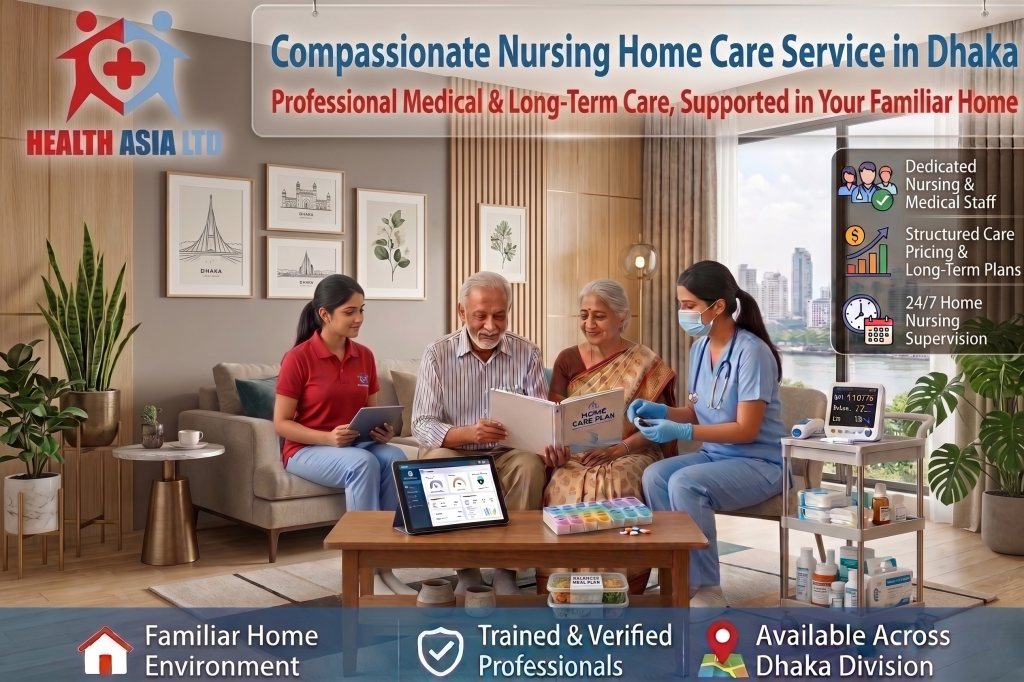
In Bangladesh, “nursing home care” refers to continuous, specialized medical and custodial support provided by registered nurses and trained caregivers. This care can be delivered within a dedicated residential clinical facility or structured as a highly intensive, hospital-like setup right inside the patient’s own home.
Basic home care services focus on daily living assistance (bathing, feeding, companionship) and are usually performed by general attendants. Nursing home care is heavily medicalized; it involves clinical interventions like IV administration, catheter management, oxygen therapy, and 24/7 vital sign monitoring by BNMC-registered professionals.
This intensive level of care is required for:
Families can tailor nursing support based on the exact medical prognosis and daily schedule of the patient.
The highest tier of support. This involves round-the-clock medical supervision, usually managed by two rotating 12-hour shift nurses, ensuring the patient’s vitals and emergency needs are covered day and night.
Ideal for families who sleep well at night but need a registered nurse to manage medications, physical therapy, and feeding while the rest of the household is away at work during the day.
Designed for patients who suffer from “sundowning” (worsening dementia symptoms at night) or require nighttime oxygen monitoring, allowing the family to sleep without anxiety.
A generic approach does not work for complex medical profiles. Specialized care is divided into:
Focuses on memory preservation, behavioral management, and strict fall-prevention protocols.
Short-term, highly intensive care focused on infection control, wound dressing, and pain management immediately following major operations.
End-of-life care that prioritizes absolute physical comfort, pain mitigation, and emotional support for both the patient and the family.
Integrates heavily with licensed physiotherapists to rebuild muscle strength and joint mobility after a stroke or severe accident.
Transparency in pricing is vital. Here is a realistic breakdown of what families should budget for comprehensive nursing care in Dhaka.
For a dedicated, clinical-level nursing setup (whether at a high-end facility or a premium home setup), families should expect to budget between 40,000 BDT and 75,000 BDT per month, depending on the severity of the patient’s condition.
Booking a single 12-hour daytime shift with a registered nurse typically ranges from 30,000 BDT to 35,000 BDT monthly. Night shifts often carry a slight premium due to the unsociable hours, costing roughly 32,000 BDT to 38,000 BDT monthly.
A standard package covers the nurse’s professional salary, agency supervision, and a guaranteed rapid replacement if the assigned staff falls ill.
Always ask if the quoted price includes the nurse’s daily transport and food allowances, as these can add thousands of Taka to your monthly bill. Medical consumables (diapers, syringes) are also billed separately.
If your loved one does not need IVs or complex medical intervention, downgrading from a “Registered Nurse” to a “Trained Caregiver” can reduce monthly costs to the 20,000 BDT – 28,000 BDT range.
Currently, local health insurance in Bangladesh rarely covers long-term private nursing care. However, professional agencies offer structured monthly invoicing to help families manage cash flow.
Do not rush the vetting process. Use this checklist to evaluate any care provider:
Ensure the provider is registered with the Directorate General of Health Services (DGHS).
Demand proof of BNMC (Bangladesh Nursing and Midwifery Council) registration for clinical nurses.
Whether assessing a facility or an agency’s equipment, hygiene must be hospital-grade.
Ensure they have backup oxygen cylinders and a clear protocol for ambulance dispatch.
In a facility, a ratio worse than 1 nurse to 4 patients is dangerous. For home nursing, it must be 1-to-1.
Speak directly to other families who have used the provider for over six months.
If checking a facility, visit unannounced during meal times to see how staff interact with patients.
The provider should insist on reviewing the doctor’s discharge summary before quoting a price.
Look for clear exit clauses and guarantees regarding staff replacements.
Never settle for the first quote. Compare at least two providers to gauge the market standard.
To protect our clients, we advise looking at service standards rather than just brand names. Here is how a premium provider compares to a standard market offering.
| Feature | Standard Market Providers | Health Asia Ltd Premium Care |
| Nurse Qualifications | Mixed (Attendants & Nurses) | 100% BNMC Registered Nurses for clinical tasks |
| Replacement Guarantee | Varies (24-48 hours) | Immediate standby deployment |
| Custom Care Plans | Generic Packages | Doctor-aligned, patient-specific protocols |
| Pricing Transparency | Often includes hidden food/travel fees | Flat-rate, transparent monthly invoicing |
| Medical Equipment | Outsourced to third parties | Integrated medical equipment coordination |
Quality is defined by consistency. A top-tier provider retains their nurses long-term, ensures strict vitals logging, and treats patients with compassion rather than viewing them as tasks to be completed.
Avoid any provider that demands 100% upfront payment, refuses to show nurse credentials, or acts defensively when you ask to see their emergency response protocols.
Arm yourself with these questions during your initial consultation.
Proper documentation protects both the patient and the provider.
You will generally need the patient’s National ID, the primary family contact’s ID, and the most recent medical discharge summary or prescription from the consulting doctor.
You have the right to terminate care if safety standards are not met, and the right to demand different personnel if the assigned nurse is not a good personality fit for your loved one.
The nursing team must maintain a strict daily logbook. This medical record belongs to you and must be available for your general physician to review at any time.
Facilities are not the only answer. Modern healthcare logistics have created excellent alternatives.
A dedicated physical facility is necessary if the patient requires heavy medical infrastructure (like ventilators) that cannot fit into a residential apartment, or if the home environment is structurally unsafe.
For 90% of families, converting a bedroom into a home-care setup is the superior choice. It eliminates the risk of facility-based infections and keeps the patient emotionally grounded in familiar surroundings.
If a patient requires continuous, minute-by-minute intervention from specialized doctors (e.g., active cardiac arrest recovery), they must remain in a hospital ICU.
Many families use a hybrid approach: hiring a 12-hour daytime clinical nurse for medical tasks, and having family members manage the basic custodial care at night.
The transition period requires patience from everyone involved.
Whether entering a facility or setting up a hospital bed at home, the first 48 hours involve establishing baselines—organizing medications, setting up equipment, and documenting the patient’s current vitals.
Patients often experience confusion or resistance during the first week. A professional nurse expects this and uses de-escalation techniques to build trust slowly.
Set clear boundaries early. Establish exactly when and how the nurse should contact you during their shift for non-emergencies versus emergencies.
Review the vitals logbook daily. Ensure the patient’s skin is being checked for bedsores and that hygiene standards are being strictly maintained.
Your job does not end once the contract is signed. Continuous oversight is mandatory.
Unexplained weight loss, sudden onset of pressure ulcers (bedsores), poor personal hygiene, or a sudden withdrawal in the patient’s personality are major red flags of neglect.
If using home care, pop into the room at unscheduled times. Check that the nurse is actively engaged, not simply staring at their phone while the patient is awake.
If you discover a medication error, or if the agency ignores your complaints regarding a caregiver’s behavior, terminate the contract immediately and switch providers.
Before making your final decision, ensure you have:
Choosing nursing care is about balancing your family’s financial realities with the deep desire to provide comfort and dignity to a loved one. By strictly vetting credentials, demanding pricing transparency, and continuously monitoring the quality of care, you can navigate Bangladesh’s healthcare system safely. You do not have to manage this heavy burden alone.
Ensure your loved one receives the highest standard of dignified, professional medical support—contact Health Asia Ltd today to discuss a tailored nursing home care plan.
Depending on whether you need a basic caregiver or a registered clinical nurse, comprehensive care typically ranges from 30,000 BDT to 75,000 BDT per month for full-time support.
Day care focuses on active tasks like physical therapy, feeding, and doctor-prescribed routines. Night care focuses heavily on monitoring vitals, managing oxygen, and ensuring safe sleep, particularly for dementia patients.
Generally, no. Private health insurance in Bangladesh rarely covers long-term domestic nursing or caregiver services. These are almost always out-of-pocket expenses.
You should request to see their Trade License and their registration with the Directorate General of Health Services (DGHS) of Bangladesh before signing any contracts.
If they are in a residential facility, visiting hours may be restricted. If you utilize a home-based nursing care setup, you maintain complete control and access 24/7.
Premium nursing care includes administering IV medications, wound dressing, catheter changes, feeding tube management, oxygen monitoring, and daily vital sign tracking.
Reputable agencies in Dhaka can typically dispatch a medically vetted nurse or caregiver to your location within 24 to 48 hours of your initial consultation.
In institutional facilities, the ratio can stretch from 1:4 to 1:8. With premium home-based nursing care, the ratio is always a dedicated 1:1, ensuring undivided attention.
Nurses performing clinical and invasive tasks must hold a Diploma in Nursing Science and Midwifery or a BSc in Nursing, and carry a valid registration from the BNMC.
Yes. Many families initially use a facility immediately after surgery, and then transition to home-based nursing care once the patient is stable enough to be moved back to their own residence.
Fill out the form below and our Care Advisors will get back to you with care information you need.