Table of Contents
TogglePortable X-ray home services in BD are changing the way patients receive diagnostic imaging. Many people need an X-ray but cannot easily travel to a hospital, clinic, or diagnostic center. Elderly patients, bedridden patients, post-surgery patients, accident recovery patients, and people with mobility problems often face serious difficulty when they need basic imaging tests.
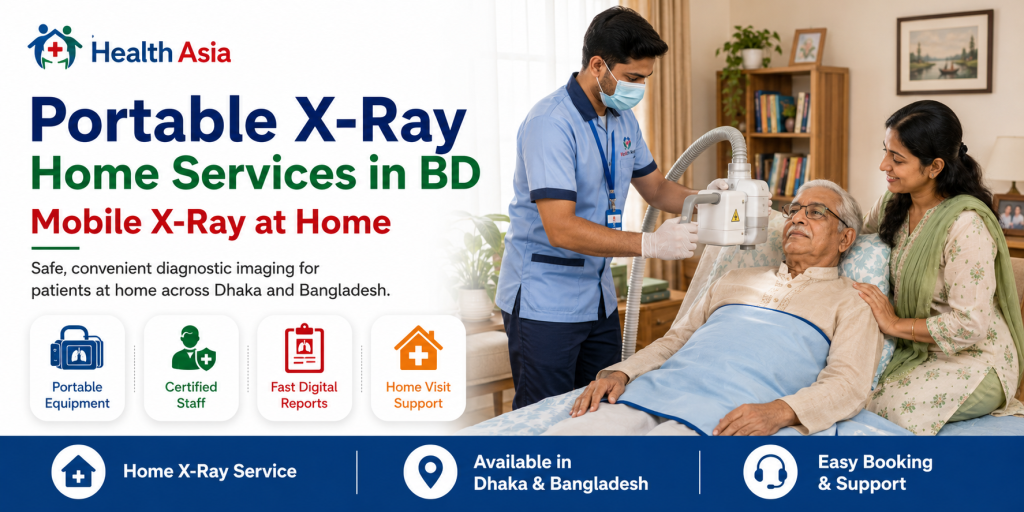
This is where mobile X-ray services become helpful. Instead of taking the patient to the diagnostic center, a trained team brings portable digital imaging equipment to the patient’s home. This service is often called X-ray on wheels, bedside X-ray, mobile diagnostic imaging, or home X-ray service.
A portable X-ray service does not replace emergency hospital care. However, it can make routine diagnostic imaging easier, faster, and more comfortable when a doctor recommends an X-ray and the patient is stable enough to stay at home.
In Bangladesh, demand for home diagnostic service BD is increasing because families want safer, easier, and more patient-friendly healthcare support. This guide explains how portable X-ray home services work, who may need them, what safety rules matter, and how to choose a reliable mobile diagnostic team.
Portable X-ray home services are diagnostic imaging services provided outside a traditional diagnostic center. A trained radiology technician visits the patient’s home with a portable X-ray machine. The image is taken at the bedside, and the digital file is later reviewed by a qualified radiologist or doctor.
The goal is simple: make basic X-ray imaging accessible for patients who cannot easily travel.
Mobile X-ray services usually follow a clear process. First, the patient or family books the service. In most cases, the provider asks for the doctor’s advice or test recommendation. Next, the team schedules a home visit. Then, the technician brings the portable imaging machine to the patient’s location.
The patient is positioned carefully. The required body area is imaged. After that, the digital image is processed and sent for reporting. Finally, the report is shared with the patient, family, or referring doctor.
This process makes mobile X-ray services useful for patients who need imaging support but want to avoid unnecessary travel stress.
X-ray on wheels means diagnostic imaging equipment is mobile. The machine can be moved from one location to another. It is designed for home visits, nursing care, elderly care, and bedside imaging.
This type of service is helpful when travel creates discomfort, delay, or risk for the patient. It brings diagnostic support closer to the patient instead of forcing the patient to visit a diagnostic center.
Home healthcare is growing in Bangladesh because families want convenience and comfort. Traffic, long waiting time, crowded diagnostic centers, and patient mobility issues make home-based healthcare more important.
Portable X-ray home services in BD are especially useful in cities where hospital visits can take hours. For many families, home X-ray support saves time and reduces physical stress.
Portable X-ray is not needed for everyone. Many patients can visit a diagnostic center without difficulty. However, home X-ray service can be highly useful for specific patient groups.
Elderly patients often struggle with movement, weakness, joint pain, balance issues, and breathing problems. Taking them to a diagnostic center can be stressful. Portable X-ray service allows them to receive imaging at home with less discomfort.
For many families, this is especially helpful when elderly parents cannot sit in traffic or wait for a long time at a hospital.
Bedridden patients may be unable to sit, stand, or travel safely. Moving them from bed to ambulance, then to a diagnostic center, and back home can be difficult.
For these patients, bedside X-ray service is a practical option. It reduces the need for shifting and allows the test to be done in a familiar home environment.
After surgery, doctors may recommend follow-up X-rays. A patient may need imaging for bones, joints, chest condition, or recovery monitoring. If travel is uncomfortable, mobile X-ray services can support follow-up care at home.
This can be helpful for patients recovering from orthopedic surgery, chest illness, injury, or long hospital admission.
Patients recovering from minor fractures, falls, or injuries may need repeat X-rays. If the doctor says home imaging is suitable, a portable X-ray can reduce unnecessary travel.
However, serious injuries should always be handled through emergency medical care.
People with paralysis, stroke history, severe arthritis, spinal issues, or disability may benefit from home diagnostic service. For them, comfort and safe positioning matter a lot.
Mobile diagnostic service helps families arrange imaging without putting the patient through avoidable movement.
Many families in Bangladesh now use home nursing or caregiver support. When a patient is already receiving home care, adding mobile diagnostic service can make treatment planning easier.
Home X-ray reports can help doctors review the patient’s condition and suggest the next step.
If your elderly parent, bedridden family member, or post-surgery patient needs an X-ray but cannot travel comfortably, Health Asia can help arrange portable X-ray home services in BD with professional home diagnostic support. Book a home visit and make diagnostic care easier, safer, and more convenient for your family.
Portable X-ray home services usually cover basic imaging needs. However, availability depends on the provider, equipment, technician skill, and doctor’s recommendation.
A chest X-ray is one of the most common imaging tests. Doctors may recommend it to check lung condition, chest infection, fluid, breathing issues, or follow-up needs.
For elderly or bedridden patients, home chest X-ray can be useful when hospital travel is hard.
Arm, leg, wrist, ankle, shoulder, knee, and elbow X-rays may be done at home depending on patient condition and equipment setup. These are often needed after falls, injuries, swelling, pain, or suspected fracture.
Some patients may need spine, hip, or pelvis imaging. However, these tests may require careful positioning. The provider should confirm whether home imaging is suitable before booking.
If the patient cannot move safely, the technician may need extra support from family members or caregivers.
Doctors may ask for repeat imaging after injury or treatment. In these cases, portable X-ray service can help monitor recovery without repeated clinic visits.
This is useful for patients who need regular follow-up but cannot travel comfortably.
Portable X-ray can be safe when done by trained professionals using proper equipment, correct positioning, and radiation safety practices. However, X-ray uses ionizing radiation, so it should only be done when medically needed.
According to the World Health Organization’s guidance on medical radiation exposure and patient safety, radiation protection in medical imaging should focus on justified use, optimized procedures, and safety for patients and healthcare workers.
This means a home X-ray should not be done casually. It should be based on a doctor’s advice or clear medical need.
A doctor decides whether an X-ray is needed. The doctor also decides which body part should be imaged and whether the test is urgent or routine.
Patients should not request unnecessary X-rays only for curiosity. Medical imaging is useful when it helps diagnosis, treatment, or follow-up.
During home X-ray, the technician should guide family members to stay at a safe distance. Pregnant women, children, and unnecessary visitors should not stay close during exposure.
The technician should also position the machine correctly and avoid repeat exposure when possible.
If the patient is pregnant or may be pregnant, the family must inform the doctor and diagnostic team before the test. The doctor will decide whether the X-ray is necessary and what protection is needed.
Portable X-ray should be handled by trained radiology staff. Proper training helps ensure better image quality, fewer repeat shots, and safer radiation use.
A poorly taken X-ray may need to be repeated, which wastes time and may increase unnecessary exposure.
Portable X-ray service offers many benefits for patients and families. It is not only about convenience. It also supports comfort, safety, and faster care decisions.
The biggest benefit is comfort. Patients can stay in their own bed or home environment. This is helpful for people who feel pain during movement or become anxious in hospitals.
For elderly patients, this comfort can make the test experience much easier.
Hospital travel can be difficult in Bangladesh, especially in busy cities. Traffic, ambulance cost, waiting lines, and patient shifting can create stress.
Mobile X-ray services reduce these problems by bringing diagnostic imaging to the patient’s home.
When a patient needs a routine X-ray, home service may help complete the test faster. Families can arrange imaging without moving the patient to a diagnostic center.
This can support quicker treatment decisions when the doctor needs an updated report.
Home X-ray service supports home nursing, physiotherapy, elderly care, and chronic disease management. Doctors can use the report to adjust treatment.
It works well as part of a complete home diagnostic service BD plan.
Some patients are weak, immune-compromised, or recovering from illness. For them, avoiding crowded places may be helpful when home testing is medically suitable.
Home X-ray service can reduce unnecessary exposure to crowded waiting rooms.
Portable X-ray is useful, but it has limits. It is not perfect for every patient or every condition.
If a patient has severe chest pain, serious breathing difficulty, major accident injury, heavy bleeding, sudden unconsciousness, or stroke-like symptoms, do not wait for home X-ray. The patient should go to emergency care immediately.
Portable X-ray is mainly suitable for stable patients who need doctor-recommended imaging at home.
Portable X-ray is suitable for many basic tests, but not all. Some cases need hospital-based imaging, CT scan, MRI, ultrasound, or advanced diagnostic evaluation.
The doctor and service provider should confirm whether home X-ray is suitable for the patient.
Good image quality depends on equipment, patient positioning, technician skill, and patient cooperation. Some patients cannot move into the correct position, which may affect image quality.
A trained technician can reduce this problem by positioning the patient carefully.
Some providers offer same-day reporting. Others may need more time. Families should ask about report delivery time before booking.
For urgent symptoms, emergency care is better than waiting for a home report.
Choosing the right provider matters. A home diagnostic service should be safe, professional, and reliable.
Ask whether the technician is trained in radiography. X-ray imaging should not be handled by untrained staff.
A qualified technician can improve safety, image quality, and patient comfort.
Digital X-ray systems can offer faster image processing and clearer workflow. Ask whether the provider uses portable digital imaging equipment.
Digital imaging can also make report sharing easier.
The image should be reviewed by a qualified radiologist or doctor. A technician may take the image, but medical reporting should be done by a qualified professional.
This is important because the report helps the doctor make treatment decisions.
A professional team should explain where family members should stand, how the patient will be positioned, and what safety steps will be followed.
If a provider cannot explain basic safety steps, be careful.
Before booking, confirm whether the team covers your area. Portable X-ray home services in BD may be available in Dhaka, Chattogram, Narayanganj, Gazipur, Sylhet, Khulna, and other major locations depending on the provider.
Service availability may vary by city, time, and patient location.
Ask for a full price before booking. The cost may include home visit charge, X-ray charge, digital copy, printed report, and urgent service fee.
Clear pricing helps avoid confusion later.
Some patients need evening or urgent support. Ask whether same-day service is available.
Also ask how quickly the report will be delivered.
Both options have value. The right choice depends on patient condition.
A diagnostic center may have larger machines, more imaging options, and direct access to other tests. It is suitable for patients who can travel safely.
It may also be better when the doctor wants multiple tests in one visit.
Portable X-ray is suitable for patients who cannot travel easily. It is more convenient but may have some limitations depending on the test type.
It is useful for elderly, bedridden, mobility-limited, and post-surgery patients.
Choose a diagnostic center if the patient can travel and needs advanced imaging support. Choose portable X-ray home service if travel is painful, risky, or difficult, and the doctor says home X-ray is suitable.
The best choice depends on medical need, patient comfort, and doctor advice.
A little preparation makes the service smoother.
Keep the doctor’s prescription, test name, or medical advice ready. This helps the technician understand the required imaging area.
It also reduces the chance of taking the wrong image.
Move unnecessary furniture, bags, or clutter from the room. The technician may need space to place the portable machine.
Good space helps the technician work safely and quickly.
The patient should wear comfortable clothing. Remove metal items near the imaging area, such as chains, belts, coins, clips, or jewelry.
Metal objects can affect image quality.
Tell the team if the patient is pregnant, may be pregnant, has implants, or has any special medical condition.
This information helps the team follow proper safety steps.
Previous X-ray reports, prescriptions, or discharge papers can help the doctor compare results.
This is especially useful for follow-up imaging.
The process is usually simple.
First, the technician confirms the patient’s identity and test requirement. Then, the machine is positioned. Next, the patient is guided into the correct position. Family members may be asked to step away during exposure.
The X-ray image is taken within a short time. If the image is acceptable, the technician completes the visit. The report is later prepared and shared.
The patient can usually rest at home after the test. X-ray itself does not usually require recovery time.
After the test, the patient should follow the doctor’s advice. The report should be shown to the referring doctor.
Patients should not self-diagnose from the image or report. A doctor must connect the report with symptoms, physical examination, and medical history.
If the patient’s condition becomes serious, emergency medical care should be taken immediately.
Bangladesh has busy roads, crowded hospitals, and many patients who need home-based care. Portable X-ray home services can reduce travel pressure and improve access to basic diagnostic imaging.
For elderly parents, bedridden patients, and post-surgery recovery cases, mobile X-ray service can be a practical healthcare solution. It saves effort and supports faster decision-making.
However, safety and quality must come first. Families should choose a provider that uses trained staff, proper equipment, radiation safety practice, and qualified medical reporting.
Need a reliable mobile X-ray service at home? Health Asia provides patient-friendly home diagnostic support for elderly, bedridden, and mobility-limited patients. Contact the team today to schedule a portable X-ray home service and get diagnostic imaging support without unnecessary travel stress.
Portable X-ray home services in BD are a helpful solution for patients who need diagnostic imaging but cannot easily visit a diagnostic center. With mobile digital imaging on wheels, families can arrange doctor-recommended X-rays at home for elderly, bedridden, post-surgery, and mobility-limited patients.
The service offers comfort, convenience, and faster support. Still, it must be used responsibly. X-ray imaging should be done only when medically needed. A trained technician should perform the test, and a qualified doctor or radiologist should review the image.
If you are looking for mobile X-ray services, choose a provider that focuses on safety, image quality, clear pricing, and reliable reporting. A good home diagnostic service BD should make healthcare easier without compromising patient safety.
Portable X-ray home service is a mobile diagnostic service where a trained technician brings a portable X-ray machine to the patient’s home and takes doctor-recommended images at the bedside.
Mobile X-ray services are useful for elderly patients, bedridden patients, post-surgery patients, accident recovery patients, and people with mobility problems.
Home X-ray can be safe when performed by trained professionals using proper radiation safety practices. It should only be done when medically needed.
Yes, chest X-ray is one of the common portable X-ray services, depending on the patient’s condition and provider’s equipment.
It is best to have a doctor’s recommendation before booking an X-ray. This ensures the test is medically necessary and correctly selected.
The imaging process is usually quick, but total visit time depends on patient condition, room setup, positioning, and service workflow.
Many mobile diagnostic services can provide digital reports online. However, delivery time depends on the provider and reporting doctor.
Yes, it is helpful for elderly patients who have difficulty traveling to a diagnostic center. It reduces movement stress and supports home-based care.
No. Some X-rays may require hospital-based equipment or special positioning. The provider should confirm whether the requested test can be done at home.
Check technician qualification, digital equipment, doctor or radiologist reporting, radiation safety practice, service area, price, and report delivery time.
Fill out the form below and our Care Advisors will get back to you with care information you need.